OSCO Games
- 4.9
- Rating
- 100.00K
- Installs
- Free
- Price

 Analysis by App-foxy
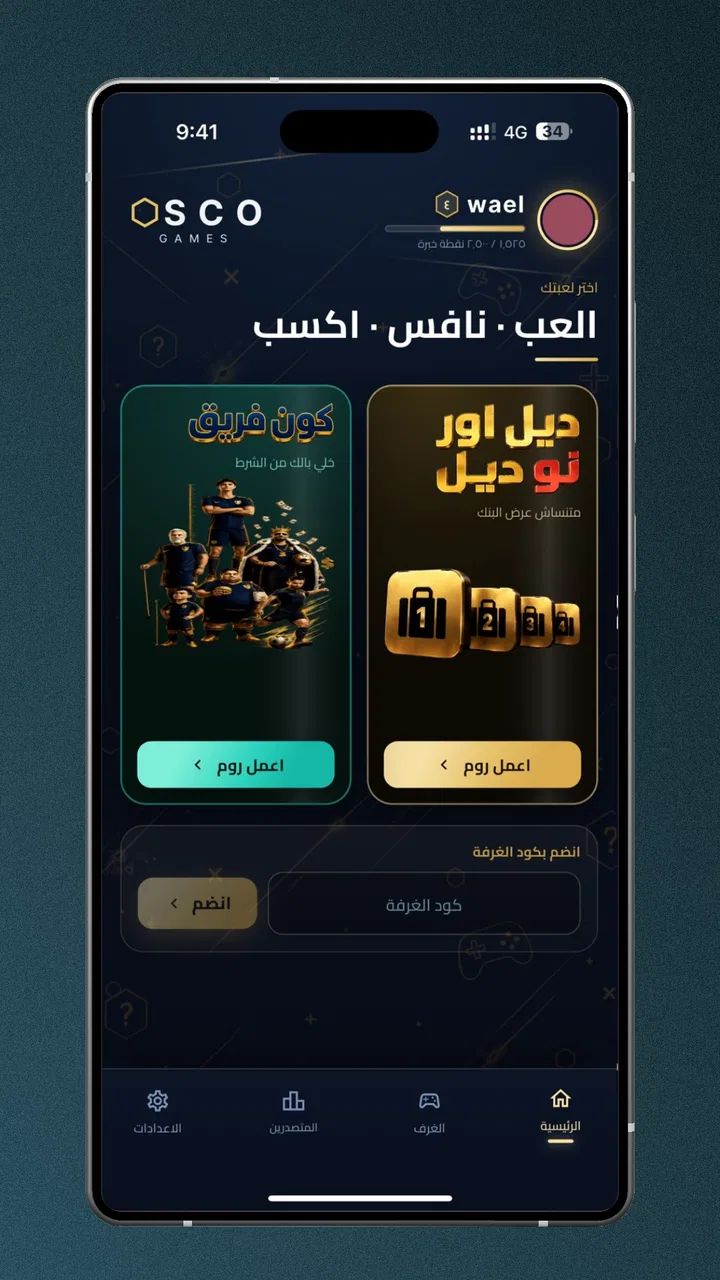
OSCO Games is a football trivia game built around a simple social idea: put several people together, give them a phone-based way to play, and let football knowledge create the competition. I found the appeal easy to understand because it does not ask you to learn a complicated control scheme before the fun starts. The interesting question is whether the game can keep a group engaged after the first few rounds, especially when everyone has a different level of football knowledge.
It comes from إقامة - Iqama and is listed as a free game in the trivia category. The central format supports groups from two to eight players, either sharing one phone or using a phone each. That flexibility matters more than it may seem. A shared screen suits a sofa, a family table, or a quick gathering, while separate phones can make the contest feel more personal when players are spread around the same room.
I would describe it as a party game first and a football quiz second. The football theme gives the questions their identity, but the real experience depends on the people playing: how quickly they answer, how confidently they guess, and how much they enjoy challenging one another. The game is free, carries an Everyone age rating, and currently appears as version 1.0.0 for devices running Android 7.0 or later.
You May Also Like

 Blood Strike: 2.5 Anniversary
Blood Strike’s Loadouts Turn Every Drop Into a Tactical Gamble
A close look at Blood Strike’s custom loadouts: how fast access to signature weapons reshapes its battle royale rhythm, rewards preparation, and narrows the gap between fights.

 Pandora - Music & Podcasts
Pandora’s Music Is Easy to Start, but Harder to Recover
Pandora’s strength is its low-effort path from a seed to a station. Its weak spot is how much confidence it asks you to place in connection, setup, and quiet recovery.

 8 Ball Pool
 Is Built on Rivalries, Rematches, and Routine
A close look at the rivalries, rematches, shared routines, and unanswered safety questions that turn a quick pool match into a persistent mobile community.

 Samsung Music
’s Quiet Strength Is Playing What You Already Own
Its reach comes less from spectacle than from dependable access to a personal library. That simplicity is both the app’s strongest retention engine and its ceiling.

 AccuWeather: Weather Radar
AccuWeather Review: A Quick, Clear Forecast for Everyday Decisions
For everyday plans, the best forecast is the one you can understand quickly. AccuWeather makes rain timing, radar, and local conditions easy to act on, with a few trade-offs.

 Hill Climb Racing
Why Hill Climb Racing Still Turns Crashes Into One More Run
A tiny car, a bumpy hill and one more upgrade: Hill Climb Racing keeps resurfacing because its simple chaos makes every near-miss feel personal.
More From Our News Desk
View All News


How the football trivia loop feels in practice
I focus on how the questions, answer feedback, and group reactions fit together, because that rhythm is what makes this football quiz feel different from playing alone. It also helps to decide early whether the group wants a shared-phone conversation or a more independent contest. That choice leads naturally to the practical setup checks that can keep a first session moving.
The first action: getting a group into the match
The most important design decision is the choice between one phone and one phone per player. With one device, the game naturally becomes a pass-and-play activity. You can place the phone in the middle of a table, let each person take a turn, and keep the focus on the conversation around the question. This is the better approach when some players are young, when not everyone has a suitable device, or when the group wants a relaxed quiz rather than a highly competitive contest.
The separate-phone format changes the mood. Each participant can respond from their own screen, which should make it easier to keep answers private until the moment of feedback. That is especially useful when a group contains both football experts and casual viewers. A knowledgeable player cannot simply watch someone else’s choice and copy it, while less confident players get a fairer chance to commit to an answer.
My practical advice is to decide the format before launching a round. A shared phone works best when the group wants banter and visible reactions. Individual phones are preferable when the group wants a cleaner test of memory. Switching between those styles is not just a technical choice; it changes whether the game feels like a conversation with questions or a proper head-to-head challenge.
The player range is also well judged for a social game. Two people can use it as a quick football duel, while a larger group gives wrong answers more entertainment value because everyone has a different theory. At the upper end, organization becomes more important. Players should agree on an order or a place to sit before starting, because passing a phone around or coordinating several screens can otherwise interrupt the rhythm.
That is one of the first trade-offs I noticed. OSCO Games is easy to explain, but a group still benefits from a small amount of preparation. Put the phones down, decide who is playing, and make sure everyone understands whether the round is shared or individual. A few seconds spent on that setup can prevent arguments later, particularly when a close answer leads to a debate.
The feedback rhythm: why each answer matters
A trivia game lives or dies by its response rhythm. The player acts by answering, then waits for the game to show how that decision worked out. That feedback is the moment that turns a question into a social event. A correct answer gives the knowledgeable player a small burst of satisfaction; a wrong answer gives everyone else a chance to laugh, explain, or argue about the subject.
In a football setting, feedback has extra energy because players often believe they know the answer before they have fully considered it. A familiar club, player, competition, or historical detail can trigger an immediate guess. The most enjoyable rounds are not necessarily the ones where everyone is right. They are the ones where the result exposes a confident mistake or confirms that a quieter player has been paying attention.
I recommend treating the feedback as part of the game rather than rushing past it. If you are playing in a group, let the person who answered explain their reasoning before the next turn begins. This creates a useful rhythm: action, reaction, brief discussion, then the next question. It also gives casual fans a way to participate even when they do not know every answer.
There is a limit, though. Players who prefer a fast, private quiz may find the social pauses unnecessary. OSCO Games makes more sense when the group values the reactions around the answers. If you want a silent session focused only on improving your own trivia score, a solo-oriented quiz app may be a better match. The shared experience is the point here, not a distraction from it.
Another useful habit is to keep explanations short. Football arguments can easily take longer than the question itself. I found that agreeing on a simple rule helps: discuss the answer, but move on once the group has had its say. That keeps the game from becoming a debate club and preserves the momentum that makes another round tempting.
The reward: competition without making the room uncomfortable
The reward in a game like this is not just a number on a screen. It is the feeling of winning a small contest against people you know. A correct answer can establish bragging rights, while an unexpected result can change the balance of the group. Because the subject is football, even a single question can create a memorable moment if it catches a favorite team or player.
The strongest use case is a casual gathering where people already want something to do together. Imagine a few friends waiting for a match, a family sitting around after dinner, or a mixed group looking for an activity that does not require everyone to be a dedicated gamer. One person can suggest a quick round, and the others can join without learning movement controls, complex rules, or a long tutorial.
It also works well as a bridge between different kinds of fans. A serious football follower may enjoy the challenge of protecting their reputation, while a casual viewer can contribute through instinct and general knowledge. To make that balance fairer, I would avoid turning the first round into a final judgment on who knows the most. Use it as a warm-up, notice which players are comfortable, and let the atmosphere develop naturally.
The reward becomes less satisfying when the strongest player dominates every question. That is not necessarily a flaw in the game; it is a common problem with group trivia. The solution is to manage the session rather than blame the format. Rotate who starts, encourage everyone to answer independently, and consider stopping while the contest still feels close. A short, competitive session is often more enjoyable than forcing a long result that everyone already knows.
For families, the Everyone rating makes the game easier to consider as a shared activity. Adults should still remember that football knowledge can vary widely by age. Younger players may know current stars while older players remember different eras, so the best conversations often come from explaining an answer rather than treating every mistake as a failure.
The session reset: knowing when to begin again
The reset is what determines whether a trivia game has a second life. After a round ends, players need a reason to start again: a disputed answer, a narrow loss, a chance to recover, or simply the feeling that the next question could go differently. OSCO Games has a natural reset point because football knowledge is broad enough for one round to feel different from the next, even when the overall activity remains familiar.
I would use short sessions rather than trying to turn the game into an all-evening commitment. Start with a small challenge, see who enjoys the format, and then decide whether to continue. This approach is particularly helpful with a mixed group. People who are not football fans may be happy to play a few rounds but lose interest if the activity becomes the only thing happening.
The one-phone mode makes resetting especially simple: finish a round, pass the device back to the starting player, and begin again. With separate phones, the group should confirm that everyone is ready before restarting. That small pause prevents one player from moving ahead while another is still discussing the previous result.
A less obvious advantage of the reset is that it gives players a chance to change the social rules. The first session can be competitive, the next can be played for fun, and a later round can focus on helping newer fans learn. Because the game is free, there is no purchase decision hanging over that experimentation. You can try the format at a gathering without asking everyone to commit money first.
Still, the reset cannot create variety by itself. If your group does not enjoy football trivia, repeated rounds will not solve that problem. The game is also not the best choice for someone looking for a deep football management simulation, an action match, or a long progression system. Its appeal comes from quick questions and human reactions, not from building a club or controlling players on the pitch.
What version 1.0.0 suggests for everyday use
The current version is 1.0.0, so I approach it as a straightforward starting point rather than a large, established platform. That makes the simplicity welcome: the game’s identity is clear, and players can understand the basic purpose quickly. At the same time, people choosing it should be comfortable with a focused experience rather than expecting the breadth of a mature football game with many different modes.
The minimum operating system is Android 7.0, which keeps the compatibility requirement relatively approachable for older Android devices. Before a group plans a session, I would still check that every phone intended for individual play can run the game. The one-phone option is a useful fallback when one participant has an incompatible device or simply does not want to install the game on their own phone.
The listing shows an average rating of 5.0 from roughly nine hundred ratings, alongside nineteen written reviews. That is a very positive reception, although I would treat the number as a signal of enthusiasm rather than a substitute for understanding the format. A highly rated social trivia game can still be the wrong choice for a person who wants solo depth or a more traditional football title.
The install figure is shown as 0+, which I would not use as a meaningful measure of popularity. What matters more for a potential player is whether the group enjoys the core loop: answer, see the result, react, and decide whether to reset for another contest. The game’s free price lowers the risk of trying it, but it does not remove the need to match it with the right kind of gathering.
Where it beats ordinary football quiz alternatives
Compared with a standard solo trivia app, OSCO Games has a clearer reason to be opened with friends. The multi-player structure makes the answer itself only half of the experience. The other half is watching confidence rise and fall around the phone. That makes it a better choice for a living room or table than a quiz designed mainly for personal practice.
Compared with a full football video game, it is much easier to start. Nobody needs to learn controls, choose a formation, or wait for a match to finish. That makes it suitable for people who enjoy football but do not regularly play football games. The trade-off is obvious: you get less control, less simulation, and less long-term progression.
Compared with a general party game, the football focus is both its strength and its boundary. A group of fans can get more emotional investment from a football question than from a random prompt. A group with little interest in the sport may find the subject narrow, even if the multiplayer structure is appealing. I would choose it when the room already has football energy, not as a universal party game for strangers.
One practical advantage is the ability to use one phone. Many multiplayer mobile games quietly assume that every participant owns a compatible device and has installed the same title. This game’s shared-device option removes that barrier. It is a small feature with a large effect on spontaneity, especially when someone joins the group at the last minute.
Who should play, and who should skip it
I would recommend OSCO Games to football fans who want a quick group activity, families looking for an accessible quiz, and friends who enjoy arguing about answers as much as celebrating them. It is particularly suitable when the group has a spare few minutes and wants something more interactive than watching a screen together.
I would be more cautious about recommending it to someone who normally plays alone. The game’s strongest quality is the social loop, so a solo player may not experience the same reward. It is also not ideal for players seeking detailed statistics, a long campaign, realistic match control, or a large competitive ecosystem. For those needs, a dedicated football simulation or a deeper quiz product would be a better choice.
Players should also skip it when the group cannot agree on a fair way to take turns. The shared-phone mode depends on cooperation, while the individual-phone mode depends on everyone being ready and honest about answering. Neither format can fix a group that talks over every question or turns every result into an argument.
My best tip is to match the mode to the room, not to personal preference. Use one phone when the aim is laughter and discussion. Use separate phones when the aim is independent answers. Keep the first session short, give everyone room to contribute, and treat the result as a reason to play again rather than a permanent ranking of football knowledge.
The loop verdict: a focused social game with a clear purpose
OSCO Games understands that a trivia game needs more than questions. It needs a first action that is easy to explain, feedback that creates a reaction, a reward that feels meaningful in a group, and a reset that makes another round attractive. Its football theme gives those steps a natural subject, while the choice between one phone and several phones makes the format adaptable.
My honest view is that its value depends heavily on the company around you. With the right group, a simple question can produce teasing, surprise, and a genuine rematch. With the wrong group, the same simplicity may feel limited. That is not a reason to dismiss it; it is a reason to understand exactly what it is before installing it.
For a free, Everyone-rated football trivia game from إقامة - Iqama, the focused design is a sensible strength. I would keep it ready for casual gatherings, match-day waiting time, and family sessions where a shared phone is more convenient than a complicated multiplayer setup. If your ideal game is a quick football contest that turns every answer into a social moment, this is worth trying.
The final test is simple: after the result appears, does someone immediately want another chance? If the answer is yes, the action-feedback-reward-reset loop is doing its job. If nobody cares who won, a different kind of game will serve the group better. In my experience, that clear division is exactly what makes OSCO Games easy to recommend to the right football crowd without pretending it is something broader than a focused trivia experience.
FAQs for OSCO Games
01What is OSCO Games, and what kind of content does it offer?
OSCO Games is a mobile gaming platform that brings together a selection of games and interactive entertainment in one application. Depending on the version available in your region, the catalog may include casual, arcade, puzzle, or other lightweight titles. The app is designed for users who want quick access to multiple games without installing every title separately, although the exact content and features can change over time.
02Is OSCO Games free to download and use?
OSCO Games can generally be downloaded without an upfront charge, but free access does not always mean that every feature is completely free. Some games or functions may include advertisements, optional purchases, subscriptions, or other limitations. Before downloading, it is worth checking the official store listing for the current pricing information and reviewing any in-app purchase details, especially if children may use the application.
03Does OSCO Games require an internet connection?
The connection requirements may vary depending on the individual games included in OSCO Games. Browsing the platform, downloading additional content, synchronizing progress, or accessing online features will usually require an internet connection. Certain games may work offline after installation, while others may depend on continuous connectivity. Testing each title separately is recommended if you plan to play while traveling or without mobile data.
04Is OSCO Games safe for children and does it collect personal data?
Parents should review OSCO Games carefully before allowing children to use it. The suitability of the content, advertisements, chat functions, and in-app purchases can differ between included games. Like many mobile applications, it may collect technical information, usage data, or device-related details according to its privacy policy. Check the age rating, permissions, developer information, and privacy terms on the official app store before installation.
05What devices are compatible with OSCO Games?
Compatibility depends on the specific Android or iOS version released by the developer. In general, OSCO Games should be installed only on devices that meet the operating-system, storage, and hardware requirements shown on the official store page. Older phones or tablets may experience slower loading, limited performance, or incompatibility with some games. Keeping your device and the application updated can also help prevent crashes and other technical issues.
Pros
- Simple interface makes the game easy to start playing.
- Lightweight design should run smoothly on many Android and iOS devices.
- Short game sessions are convenient for quick breaks.
- Bright visuals give the experience a friendly
- accessible feel.
- Suitable for casual players who prefer low-pressure gameplay.
Cons
- Gameplay may feel repetitive after extended sessions.
- Limited depth could disappoint experienced or competitive players.
- Some features may require an internet connection.
- Ads may interrupt play
- depending on the version and device.
- Performance can vary on older phones or tablets.

OSCO Games
Gallery